
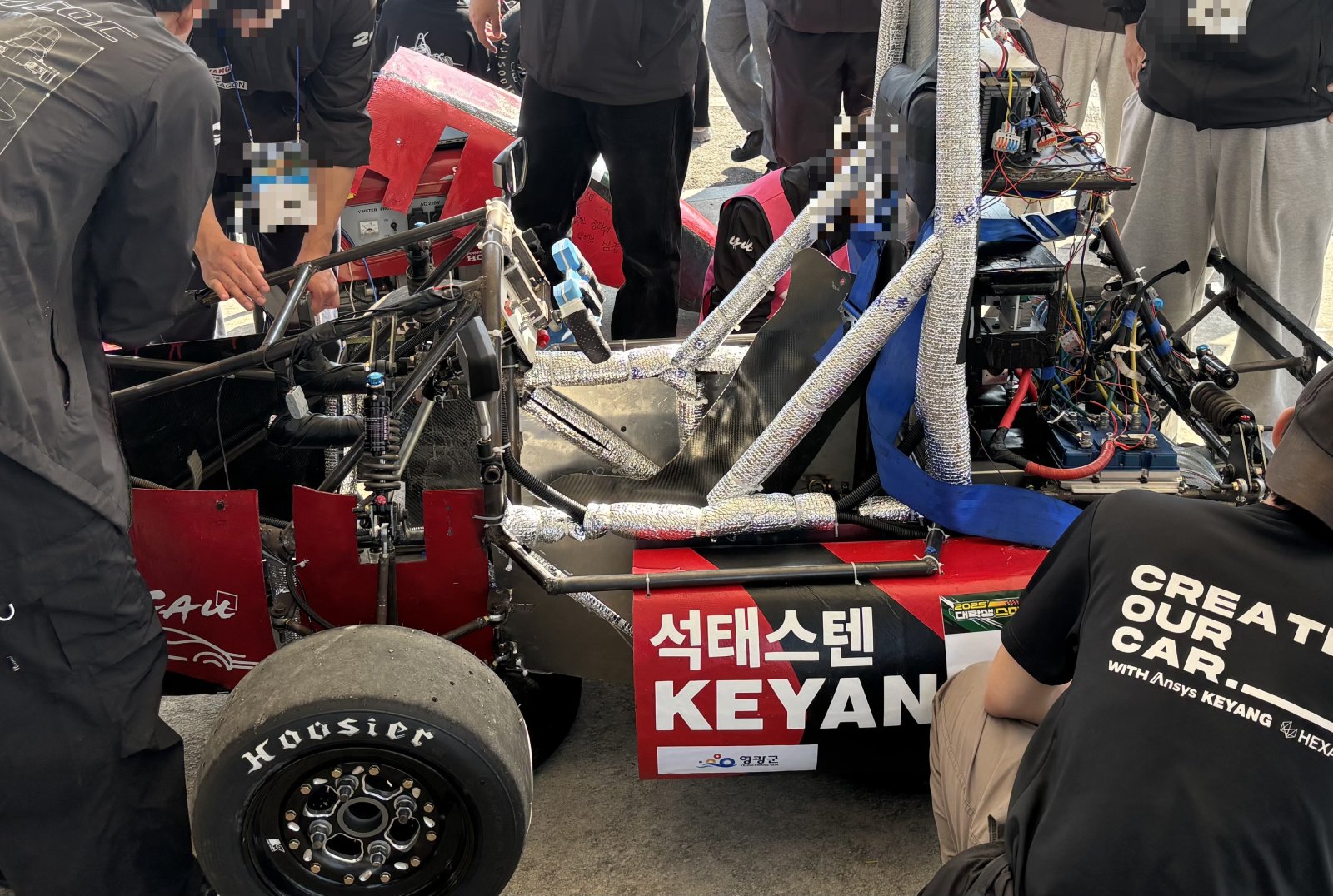
At 4:30 p.m. on the second day of the competition, everyone else went to the hotel for dinner. I stayed in the paddock with a motor controller I couldn’t keep my hand on. Our two endurance heats were done, our lap times had gotten worse all afternoon, and the water pump that was supposed to be cooling that controller wasn’t turning.
The controller was a Golden Motor VEC500 — 48 V, 10 kW, water-cooled. We had already killed two motor controllers that season. I was not going to be the guy who explained a third one.
The short version: the pump had power and moved no coolant, because a rock was wedged against the impeller. Every time I cycled the supply, current would come in, drop out, come in again. I read that as a pump dying on me. It was actually an impeller jamming and breaking free. If an electric pump stutters and nothing circulates, suspect a mechanical obstruction before you condemn the electronics. It took me two hours and a lot of phone calls to learn that.
The symptom: lap times that got worse every lap
Day two was two endurance heats, and we drove both of them conservatively. We weren’t chasing a fast lap. We were trying to finish, because the car had thrown a new small failure at us every single day of that weekend — including a slalom score of zero on day one.
Even driving carefully, the lap times drifted. Not a cliff — a slow bleed, lap after lap, through the second heat. When the car came in at 4:30, I put my hand on the controller case and took it straight back off. It was too hot to hold.
Our reading is that the controller was pulling power back to protect itself as it heated up, and that’s why the laps kept getting slower. I want to be honest about the evidence there: we never logged controller temperature. We had my hand, and a lap chart going the wrong way. It’s our best explanation and we never confirmed it with data.
What wasn’t inference: the coolant pump wasn’t spinning. That controller sheds heat into a water loop, and the loop had stopped moving. Ours also runs hot for a reason we chose — we’d turned the battery current limit way up earlier in the season to make the car quick. More current through the controller means more heat to get rid of. Take the cooling away and it’s a matter of laps.
Why I spent two hours refusing to open the pump
I decided the pump was dead before I had any evidence that it was. That’s the whole mistake, and everything after it was me defending the decision.
I pulled the pump, put it on a bench supply and cycled it. Current in. Current out. In. Out. To me that looked exactly like a pump with a failing board — the kind of thing you replace, not repair. So at six in the evening I started phoning fish farms near the circuit, because a fish farm is a place that owns small circulation pumps and might sell me one on a Saturday night. That is a real sentence about a real hour of my life.
A teammate from mechanical engineering kept telling me to just open the thing. I kept refusing, and my reason sounded smart: there is nothing inside a sealed pump that I can fix in a paddock with a multimeter. I’m not re-soldering a potted control board on a folding table at 6 p.m. So why open it?
Because “I can’t fix what’s inside” is not the same as “I know what’s inside.” He was right and I was stubborn, and the cost was roughly two hours, a skipped dinner, and a stack of pointless phone calls.
Water pump runs but no coolant flow: what to check first
If a water pump runs but no coolant flows, the usual suspects are an air pocket trapped in the loop, a thermostat stuck closed, or an impeller that isn’t doing its job — a plastic impeller can spin loose on its shaft and move nothing while the pump sounds perfectly healthy. On a normal car the tell is a temperature gauge climbing while the heater blows cold air and the upper radiator hose stays cool. Noise is not flow. Current is not flow. Flow is flow.
What our weekend adds to that list is the current signature, and it’s the part I’d want someone to tell me before I burned an evening:
- Confirm flow, not sound. With the system cold and unpressurized, look for actual movement in the reservoir or feel the hose. A humming pump proves the motor is energized, nothing else.
- Watch the current, not just the voltage. On an electric pump, put a meter on the supply lead. A multimeter is the cheapest witness you have.
- Read the shape of the current. A pump under a steady hydraulic load draws a steady current. Current that stutters — in, out, in, out — is a mechanical story, not an electrical one. Something is loading and unloading that shaft.
- If it stutters, stop testing electronics and open the housing. Four screws. Do it before you spend two hours sourcing a replacement you may not need.
One safety note, because a race car with a cold loop is not a road car with a hot one: never open a cooling system that’s hot. It’s pressurized, and the coolant will find you. Let it cool completely.
What was actually inside the pump
I opened it. Inside there’s an impeller sitting in a round housing, and the gap between the two is narrow. Sitting in that gap was a rock.
Everything snapped into place backwards. The impeller would jam against the stone, the pump would stall and stop drawing current properly, the rock would work loose, the impeller would turn for a moment, and it would jam again. My “failing control board” was a pebble doing exactly what a pebble does.
I picked it out. The pump spun. Coolant moved. The controller came back down to a temperature I could touch. I finished at 7 p.m., two and a half hours after everyone else left for dinner, holding a small rock and feeling stupid in a way that was, at that moment, entirely fine with me.
I still don’t know how it got in there. Best guess: it went in with the coolant when the loop was filled in a gravel paddock, but we never confirmed it, and the pump went straight back on the car and ran the rest of the weekend without complaint.
The part that made the rock worth it
The mood in our garage that day was a funeral. Two endurance heats, a car that had broken something new every day, lap times going the wrong way, and half the team convinced we were finished.
Then the standings went up that night. We were in the semifinal — the last team through the door. Nobody in that car park cared about the rock anymore.
So we went back to the hotel, charged the pack, and turned the battery current limit up for the semifinal, because if you’ve made the last spot in the field you may as well arrive fast. At the time that felt like the obvious thing to do. It was, in a way I didn’t understand until the next afternoon, also the reason the car and I would end up in the paddock again, staring at a dashboard that had gone dark.
We film most of our testing. The clips from the season are on the CarVoltLab YouTube channel.
Series: This is part of Field Notes — everything that broke on our Formula Student EV car, in the order it broke.