
Reverse polarity damage sounds like something that needs big voltage. It doesn’t. At 8 p.m. on the night before our first test week, I connected a thin wire to our accelerator pedal with supply and ground swapped. The controller made one small click. Then nothing — no fault code, no beep, no light. Ten seconds, one wire, and a motor controller built to switch hundreds of amps was dead. The wire that killed it was carrying twelve.
I’m the electrical systems lead on a student-built EV race car — Create Our Car (COC), Chung-Ang University’s Formula Student team, racing in the EV class of Formula Student Korea — and this is the most expensive mistake I have personally made. It’s also the one that transfers most directly to your car, because your car is full of parts that die exactly this way.
What Reverse Polarity Damage Actually Does
Reverse polarity damage is what happens when a component’s supply and ground are swapped, forcing current backwards through circuits built to carry it in one direction only. Semiconductors are one-way streets. Run current the wrong way through them and they don’t complain — they conduct, they heat, and they fail, faster than any fuse can react.
The thing that fooled me is simple: the numbers on the box tell you nothing about this. Ours was a Kelly KLS8080N, a controller that will happily push several hundred amps into a motor. Reverse polarity damage doesn’t care. It walked in through a connector the size of my thumb.
The Ten Seconds
We were behind. Test week started the next morning, the car had never turned a wheel under its own power, and we were doing the thing every team does the night before: connecting the last few things fast.
The accelerator pedal lands on a three-pin connector — ground, signal, and a 5-volt supply the controller generates itself. Everything else on our bench ran off the car’s 12-volt low-voltage bus. And our wiring, by that point in the build, was whatever colors we had left on the reel. Red wasn’t always positive. Black wasn’t always ground. We knew that. We’d been living with it, because it had never cost us anything yet.
I got the supply and the ground backwards.
There was a click. Not a bang, not smoke, not even a smell — just a small mechanical click, and then a silence where the startup sequence should have been. I waited for the controller to do literally anything. It never did anything again.
We Bought a Train Ticket for a Motor Controller
Nobody in the city had a spare KLS8080N on a shelf at 8 p.m., and test week did not care.
Another university team, four hours south of us, had one they could sell. So we bought a high-speed rail ticket. A seat. A seat meant for a person. They put the box on the train, the train did what trains do, and we collected our motor controller at the station like a relative coming home for the holidays. It was on the workbench by 11:30 that night.
I laughed about it then and I still think it’s funny. I also still think about what it cost, which was an amount of money a student team feels in its bones.
Why 48 Volts of Rating Didn’t Save It
I couldn’t work out why at the time. Twelve volts, on a car whose battery pack sits at 48, killing a controller rated far above that? It made no sense. The answer was on the manufacturer’s spec sheet the whole time.
That controller contains two completely separate electrical worlds. There’s the power stage — the big terminals, the ones that shove hundreds of amps into a motor. And there’s the logic side: the small connector where the pedal, the sensors and the switches land. Kelly’s own datasheet spells out exactly what lives there: a logic supply of 8–20 volts, and a throttle input of 0–5 volts.
The power stage’s ratings protect the power stage. They do nothing at all for the 5-volt side. When I reversed supply and ground on that pedal connector, I pushed our 12-volt bus backwards into a 0–5 volt analog input. Twelve volts is trivial next to 48 — but it is more than double what that input expects, arriving from the wrong direction. No fuse blew, because from the fuse’s point of view, nothing unusual happened at all. We never did a teardown, so I can’t tell you which component gave up first. I can tell you the car never started again.
The number on the label describes the muscle. It says nothing about the brain.
This Is Exactly How Car Electronics Die
Reverse polarity damage is not a race car problem. It is a car problem. Your low-voltage system is 12 volts, and 12 volts feels harmless. It has destroyed more electronic control units than lightning ever will. Nearly every sensor in a modern car — throttle position, MAP, coolant temperature, pedal position — runs on a 5-volt reference generated by the ECU, exactly like our throttle input did. If you want to see what one of those signals actually looks like, I measured ours: 0.85 volts released, 4.2 volts floored.
Touch 12 volts to one of those 5-volt lines and you are doing to your ECU precisely what I did to our controller. Same mechanism. More expensive part.
Four Rules for Anyone Building a Formula Student Car
If you are on a student team heading to a Formula Student event, the low-voltage side will destroy more of your parts than the tractive system ever will. Nobody on our team was hurt by 12 volts. Our budget was. These are the four rules that came out of it, and every one of them is written in a part we had to buy twice.
- Never trust a wire’s color. On a student car, colors are whatever was left on the reel by week six. Our three-phase motor cables were beautifully coded — yellow, green, blue. Our thin signal wires were not. Guess which ones killed a controller.
- Meter first, connector second. Thirty seconds with a multimeter tells you what a wire actually is. I had a meter on the bench that night and didn’t use it, because test week started in the morning. Every team is in a hurry the night before test week — that is exactly when this rule pays for itself.
- Photograph every connector before you unplug it. Your memory of which way it went is worse than you think at 2 a.m., and on a car that gets rewired three times a week, the harness in your head stopped matching the harness in the car a long time ago.
- Read the logic-side ratings, not the headline number. Your controller’s datasheet describes two separate worlds. The power stage takes hundreds of amps. The logic side wants an 8–20 V supply and a 0–5 V throttle input. The big number on the box protects the muscle, not the brain.
There is a fifth rule, and it isn’t electrical: know where your spare is before you need one. At 8 p.m. the night before test week, nobody in the city had a KLS8080N on a shelf. A team four hours south of us did. Find out now which teams near you run your controller, your pedal, your BMS — because the night you need that phone number, you will not be in any state to go looking for it.
And stop thinking of 12 volts as safe. It isn’t high enough to hurt you. It is exactly high enough to kill everything your car uses to think — and reverse polarity damage is the fastest way to prove it.
The Meter Was Right There
The part that still stings is that we had already been taught this lesson, weeks earlier, for free. I watched a teammate destroy an entire data-logger board by touching a probe across a live circuit. Same family of mistake, same result: a dead board, a reordered parts list, and everybody saying the words “we’ll be more careful.”
Then, three weeks later, at 8 p.m., in a hurry, I flipped two wires.
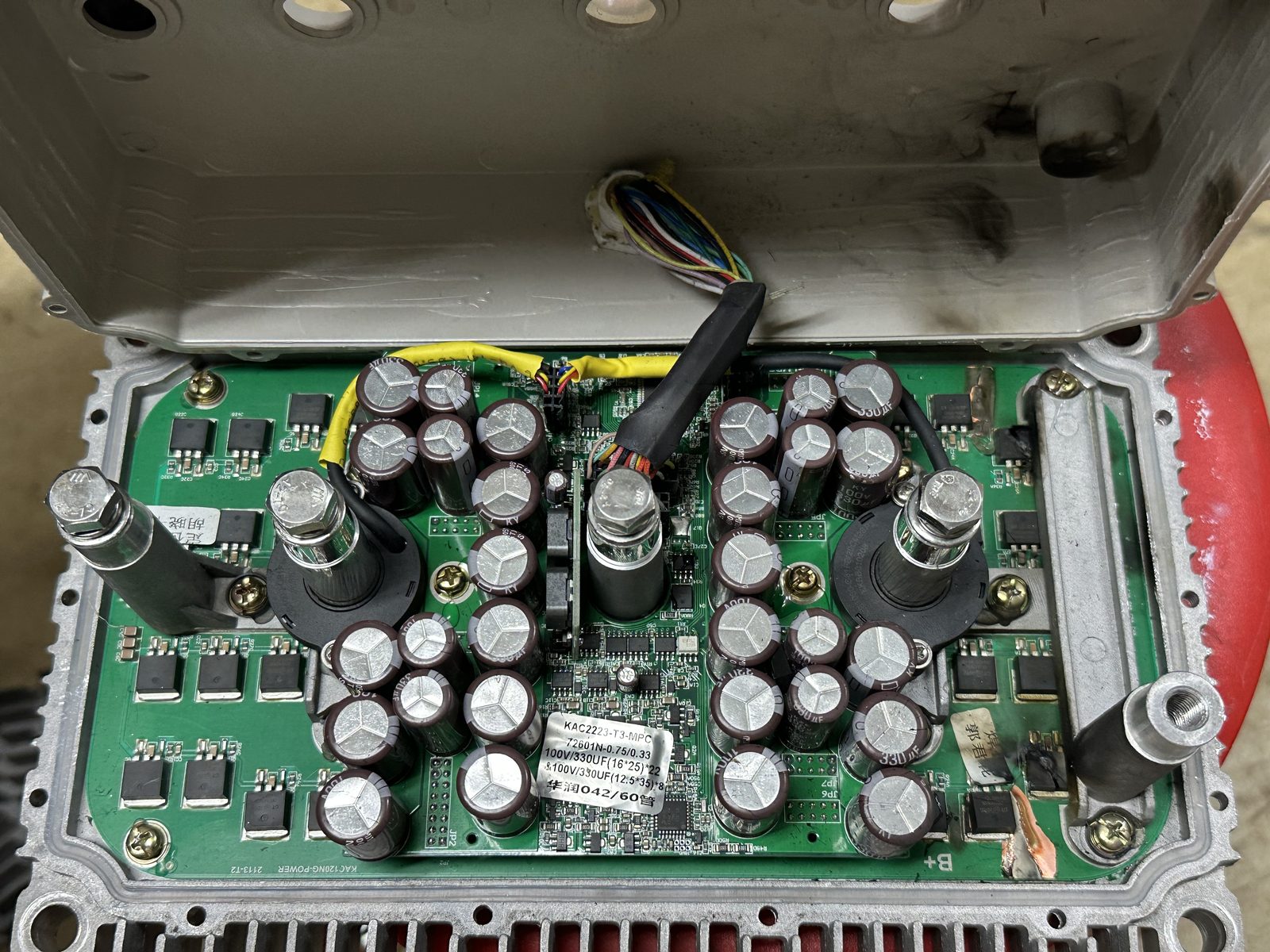
That replacement controller — the one that rode the train — didn’t survive the season either. Reverse voltage again, arriving from somewhere else entirely. It wasn’t my hands on the wire that time, and it took us far longer to find. The photo at the top of this post is that one, with its lid off. That’s what a few volts going the wrong way looks like once you get inside the box: no drama, no flames, just quiet black marks where the current went somewhere it was never meant to go.
Bonus: The Controller We Killed Before This One
The KLS8080N was not our first. Reverse polarity damage is the quiet way to destroy a controller. This is the loud way.
That bang is two ring terminals touching each other. Look at the bench in the first second of the clip: heavy orange cables, ring lugs bolted down to a busbar, studs sitting close together. There simply wasn’t enough clearance between the lugs. Under load, they made contact, and a battery pack that can deliver hundreds of amps did exactly what it was built to do.
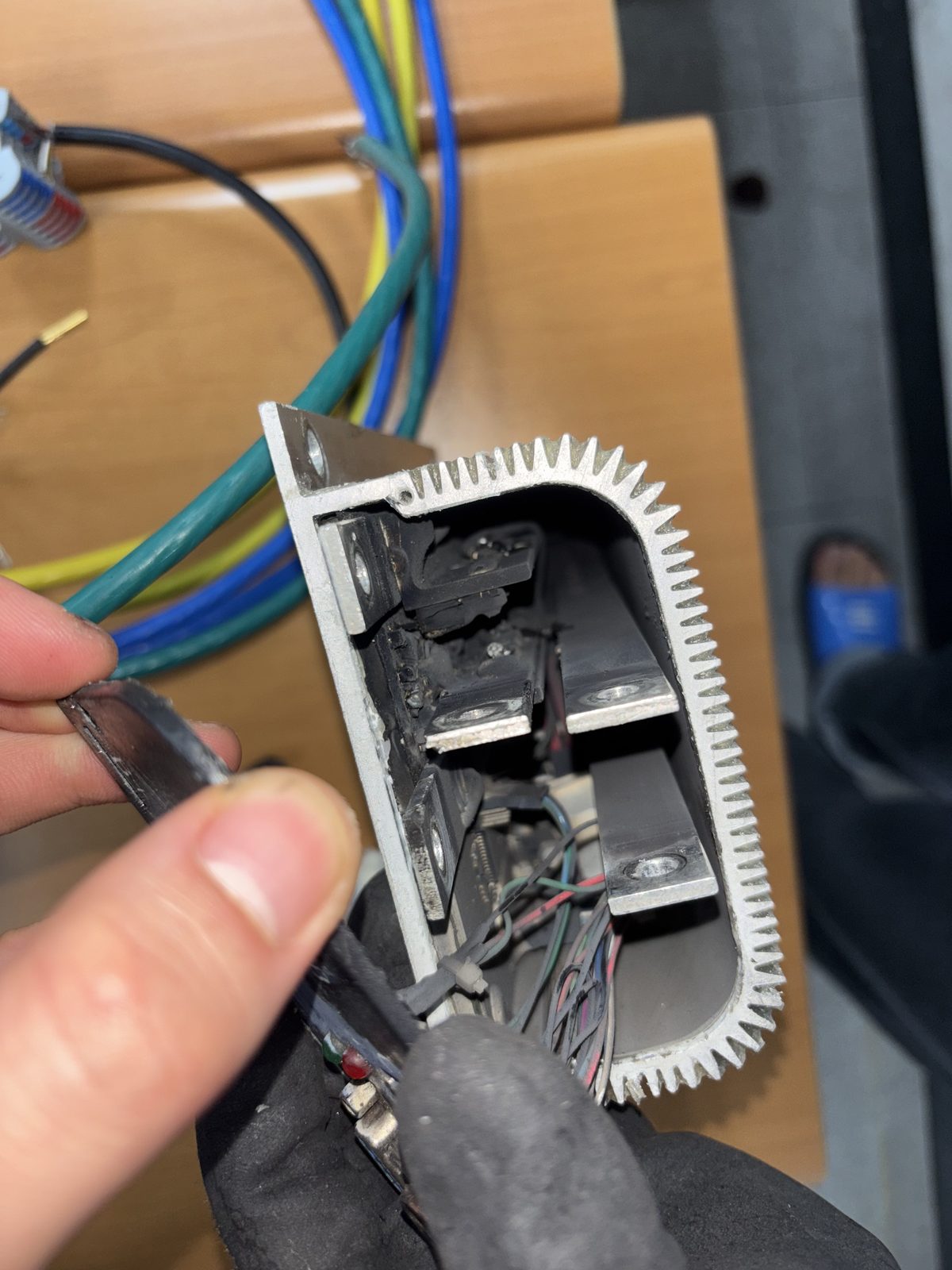
The fix costs nothing and takes five minutes: space your lugs out, and insulate them. Heat-shrink over the barrel, a fibre or plastic washer between adjacent studs, and enough physical distance that a lug can rotate under torque without reaching its neighbour. If two ring terminals can touch, assume that one day they will. And pick the right material for the job while you are at it — we later found out the hard way what happens when you try to insulate a battery with electrical tape.
Two controllers, two completely different failures, one root cause: we built things that only worked if nothing moved and nobody made a mistake.
— Field Notes #1
Series: This is part of Field Notes — everything that broke on our Formula Student EV car, in the order it broke.