
Our race car’s battery pack read 58.3 volts fully charged, and the thing telling me that cost about thirty-five dollars. It’s a TASI TA801A — red rubber holster, two AAA batteries, bought with team money at the start of the season. It spent a year in a workshop, a paddock and a pit lane. It still works. If you’re wondering whether a cheap multimeter for car electrical work is good enough, that’s most of the answer already.
The short version: on a 12-volt car, a $35 meter with a continuity beeper handles almost everything you will actually do — dead fuses, broken wires, bad grounds, battery voltage. What you give up is resolution, sampling speed, and the ability to measure any current worth measuring. Those limits are real. In driveway work you will almost never hit them.
What a $35 Multimeter Actually Did on a Race Car
Four settings did all of it: continuity, DC volts, resistance and DC current. Nothing exotic. Across a full season I never needed a mode this meter doesn’t have.
The continuity beeper got the most use by a wide margin. Our wiring was rebuilt so many times that looking at it was worthless — I’ve written up the whole method for finding a car wiring problem with a multimeter separately, but the summary is that you probe segment by segment until the beeping stops, and the broken thing is wherever that happened. That one mode found a dead connector, a break hiding inside an energy meter, and more bad crimps than I want to admit.
DC volts came second. Pack voltage on the bench, the 12-volt rails feeding the low-voltage side, throttle sensor output while somebody pressed the pedal. The pack in the photo below is a 48-volt nominal system running through a DALY BMS, reading 58.3 volts fully charged. The TA801A’s DC range goes to 600 volts, so nothing on our car came close to stressing it.
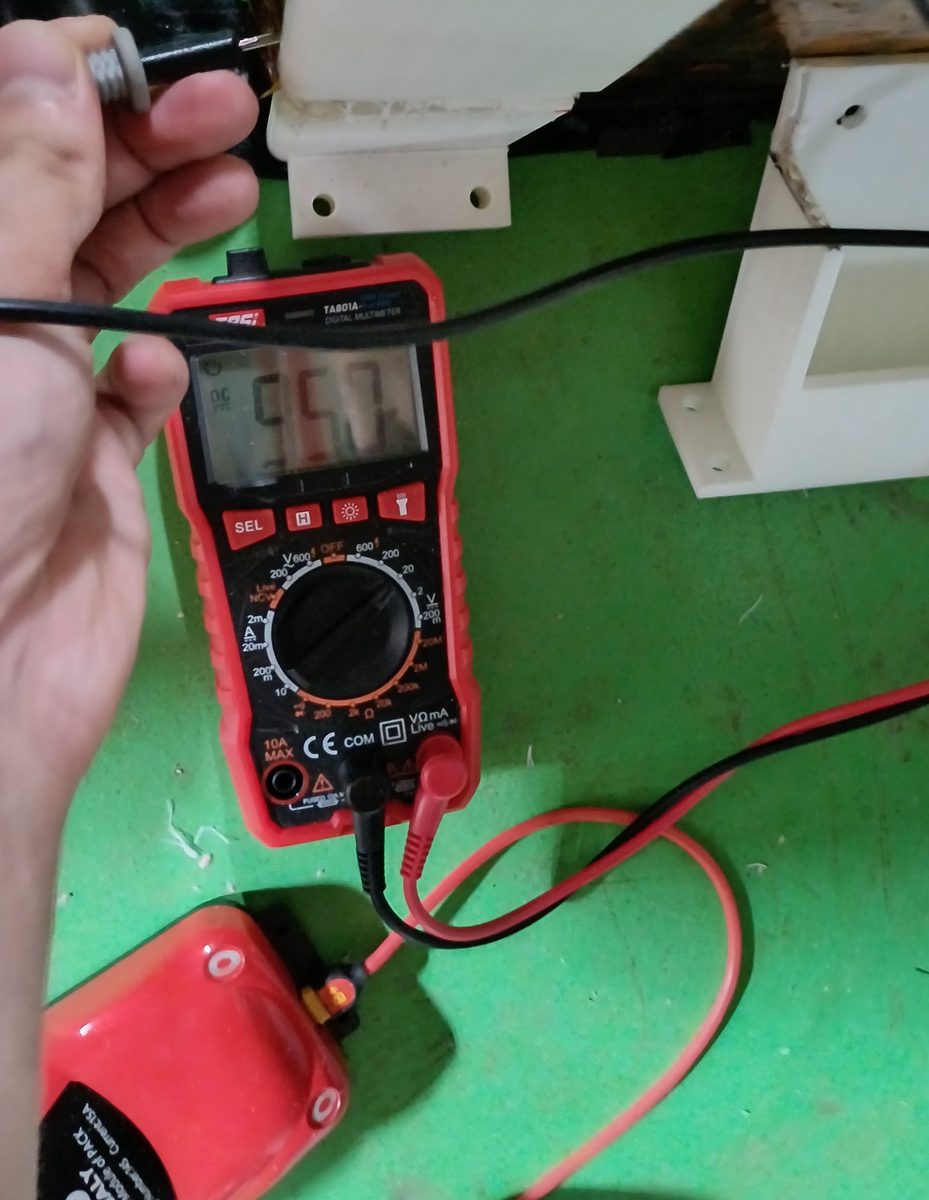
Resistance and DC current rounded it out — resistance to prove a wire was still a wire, current only on the low-voltage side, for a reason I’ll get to. The one mode I never used on the car was the NCV live-wire detector. That’s for finding AC mains inside a wall, and a car doesn’t have AC mains in it. It sits on the dial of almost every cheap meter sold now, and on a vehicle it is decoration.
The hardware has held up better than I expected for the money. Rubber holster, backlight, a small flashlight in the top edge, data hold, 15-minute auto shutoff, 148 × 70 × 42 mm, 188 grams. A full competition season later it still reads correctly — which is the part I would have bet against on the day we bought it. It has now outlived a handful of connectors, one energy meter, and two motor controllers.
Where a Cheap Multimeter Stops
There are three hard limits on a meter at this price. All three are printed on the tool or sitting in its spec sheet, so none of them are a trick. They just don’t get mentioned in buying guides.
Resolution. The TA801A is a 3½-digit meter — 1999 counts. On the 200-volt range that means it steps in tenths of a volt, which is exactly why the pack read 58.3 and not 58.34. For “is this battery charged,” tenths are plenty. For comparing individual cells that differ by a few thousandths of a volt, tenths tell you nothing. This is the one limit I genuinely ran into, and it’s the honest reason to spend more.
Manual ranging. Look at the dial in the photo: 600, 200, 20, 2 and 200m are all separate positions. You have to know roughly what you’re about to measure before you measure it. On a 12-volt car this barely matters — park it on the 20-volt DC range and leave it there all day. It gets old when you’re jumping between a 58-volt pack and a millivolt-level sensor signal, which is a race car problem more than a driveway problem.
Current, and speed. The current jack is marked 10A MAX and it’s fused. Our motor controller was configured to pull 185 amps of battery current, and you do not put a handheld meter’s probes anywhere near that — that’s a clamp meter or a shunt-based logger. The meter also samples about three times a second. Anything that spikes and disappears between samples is invisible to it, which is fine for wiring faults and useless for chasing electrical noise.
What Actually Matters When You Buy a Cheap Multimeter for Car Work
Four things matter at this price, and one heavily advertised feature doesn’t matter at all on a car.
A continuity beeper is the only non-negotiable. It’s the mode that finds broken things, and you want to hear it rather than read it, because your eyes are on the connector and your hands are somewhere awkward. Most meters have one. The very cheapest ones sometimes don’t, and those are the ones to walk away from.
A DC range that shows two decimals around 12 volts. A car battery lives in a band where hundredths decide the answer: roughly 12.5 to 12.7 volts rested and healthy, low 12s when it’s tired, somewhere near 14 with the engine running and the alternator working. A meter that can separate 12.6 from 12.4 can make that call. One that rounds to whole volts can’t.
A fused current jack, with a fuse you can actually buy. In current mode the probes are connected almost directly together inside the meter. Touch that to a live circuit and something has to give — you want it to be a fuse. Check before buying that it’s a standard size, because a cheap meter with an unobtainable fuse is a disposable meter.
Auto-ranging is the one upgrade worth the extra money. It’s usually about ten dollars, and it deletes the only genuinely irritating thing about using a manual meter in a badly lit engine bay.
And then the one to ignore. Skip True RMS. The TA801A’s own listing advertises it, and every “best multimeter” roundup treats it as the mark of a serious tool. True RMS only changes the reading on distorted AC waveforms — household wiring, motor drives, dimmers. Car electrics are DC. In a season of measuring a car, True RMS never once changed a reading I took. If two meters are otherwise identical and the one without it is cheaper, buy that one.
I’m not going to tell you which cheap meter is best, because I’ve used exactly one of them for a year and haven’t touched the others. What I can tell you is what to check the spec sheet for. Two that clear the list above on paper are the AstroAI 6000-count TRMS and the KAIWEETS HT118A — both auto-ranging, both with a continuity beeper, both under fifty dollars. The Klein Tools MM325 is worth knowing about too, but read the spec before you click buy: it’s manual-ranging, exactly like mine, so you’d be signing up for the one annoyance I just described. Run the four checks yourself against whichever one you land on.
The meter in that photo cost about as much as a tank of gas, and it survived a season that killed considerably more expensive hardware — the rest of which is written up in the Field Notes series. A cheap multimeter for car electrical work isn’t a compromise. It’s the correct tool, right up until you need to measure something in thousandths of a volt, or something that moves faster than three times a second. In a driveway, you will almost never need either.
This post links to products on Amazon. They are not affiliate links and CarVoltLab earns nothing if you buy through them.