
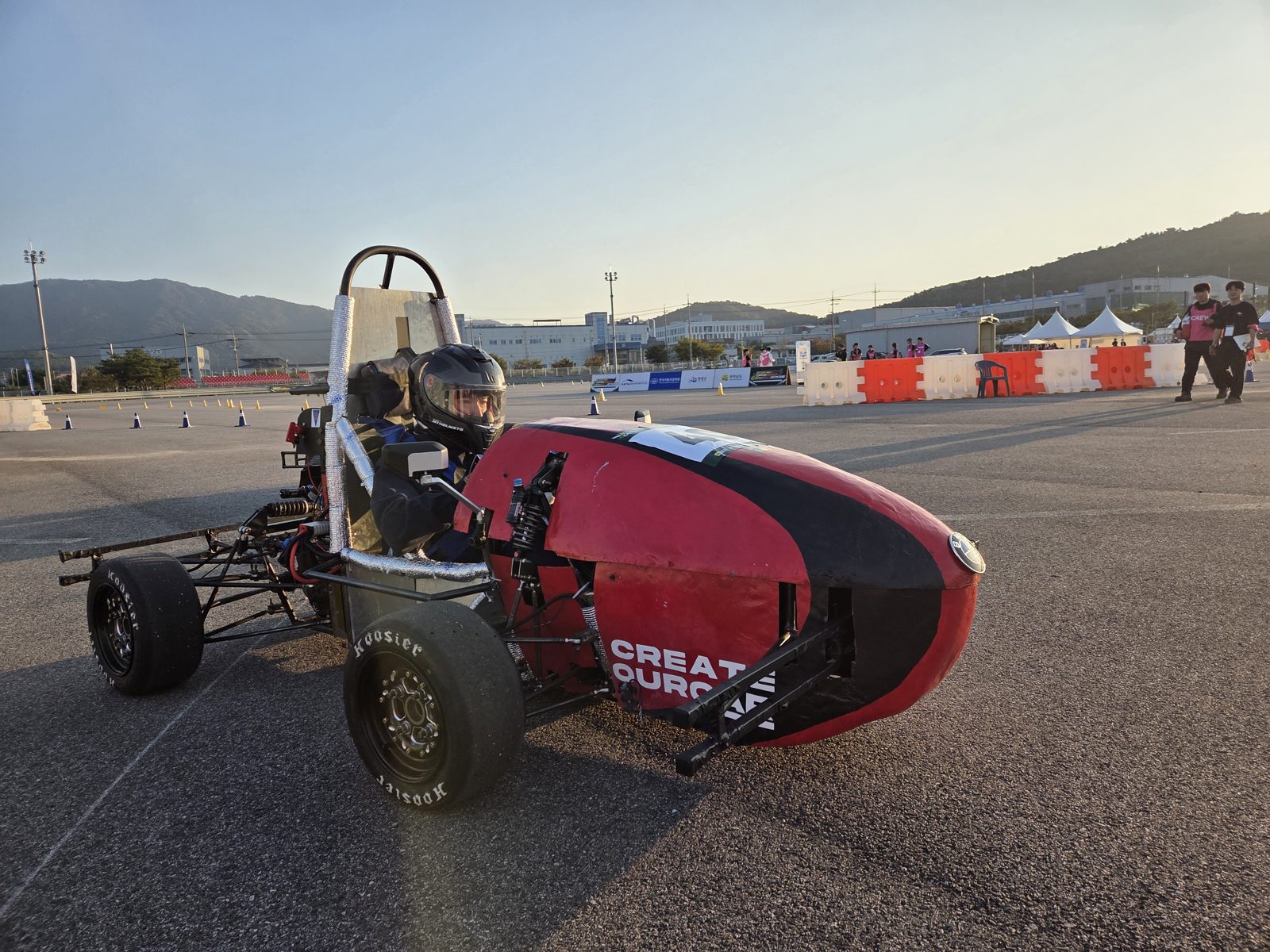
Seven laps into the endurance semifinal, our car was half a corner from taking the lead. Then the dash went dark and it rolled to a stop.
The part that killed it was a relay the size of a matchbox. If you want the fastest possible summary of relay failure symptoms: everything upstream was healthy, everything downstream was dead, and the little module in between had been quietly cooking itself for two days.
This was day three of the competition — the last day this car ever raced. We lost the semifinal standing in the paddock. Then we did something in the last-chance race that I wouldn’t trade for a trophy.
The short version: a relay that carries heavy current for hours can fail with no warning, and when it does, the thing it feeds simply stops existing. Ours fed the main contactor. No relay, no contactor, no high voltage, no car. A multimeter found it in minutes. The two days of decisions that killed it took longer to understand.
Relay Failure Symptoms: Everything Works Until Nothing Does
A relay is a switch that another circuit is allowed to press. A small control current pulls the contacts closed, and those closed contacts carry the real load. That means a dying relay gives you almost no warning — the contacts are either passing current or they aren’t.
On a road car it shows up as an engine that cuts out for no reason and restarts fine, a fuel pump that goes silent, headlights that die as a set, or a car that starts one morning and not the next. The tell is that everything feeding the relay tests perfectly. Battery good, fuse good, wiring good. The fault is inside a sealed part that costs a few dollars.
Ours sat on the third level of an electrical hub we never had time to simplify, and switched power to the main contactor — the big relay that connects the battery pack to everything else. When it failed, the contactor dropped out and the entire high-voltage side of the car disappeared mid-corner. No error code. No warning light. The car just stopped being a car.
I Traced It With a Multimeter and the Trail Stopped at the Relay
We pushed the car back to the paddock and I did the only thing that has ever worked on this car: stopped guessing, started measuring.
Follow the power from the source toward the dead thing and check it at every junction. Voltage was there on the input side of the relay module. On the output side there was nothing. The contactor coil was being fed by a relay that had stopped passing current. That’s the entire diagnosis, and it took a fraction of the time it took to accept it.
It’s the same routine we’ve used on every electrical failure this car has thrown at us. Chasing a wiring problem with a multimeter is slow and boring, and it’s the reason we know what actually happened instead of having a theory about it.
Why It Burned: We Made the Car Faster and Forgot What Else That Meant
Our conclusion is that the relay died of current, not of age. It was a cheap module — the kind that ships in a five-pack — and it had been holding a heavy load closed, for long stretches, across three days of running. Contacts under that kind of duty heat up, and heat is what eventually pits or welds them into uselessness.
I want to be exact about the evidence: that’s our conclusion from what the meter showed and what the part was, not a bench teardown. We never cut the relay open to look at the contacts. What we know for certain is that voltage went in and nothing came out.
Here’s the misjudgment, and it cost us the semifinal. All weekend we obsessed over heat — but only the expensive heat. We watched the motor controller. We pulled the water pump apart when the coolant stopped moving. The night before this race we charged the pack and pushed the controller’s current limit up again, because we’d finally learned that current is what makes the car fast.
More current through the car means more current through every part that carries it. We thought about that for the controller and the cable. We never once thought about the two-dollar relay sitting in the middle of it.
The Fix Was a Deletion, Three Minutes Before the Grid
We had one race left — the last-chance race — and no time to source a relay we trusted.
So we deleted it. We cut the dead relay module out of the loop and fed the contactor directly, so that nothing small and cheap sat between the pack and the switch that mattered. It’s not a design I’d defend in a report. It got the car to the grid.
Then, three minutes before our race was called, we powered the car up and heard it: a crackle from the step-down converter. Not a good noise. Nobody had time for a diagnosis, so we made the call in about ten seconds — cut that circuit out too, right there, and go race. We rolled to the line with a harness we’d modified ninety seconds earlier.
If you’re doing this on your own car: a pack that can push hundreds of amps doesn’t care how good your intentions are. Isolate the pack and open the high-voltage circuit before you touch anything, and don’t work on a live system because a clock is telling you to. Copy the diagnosis, not the panic.
Then We Took the Limits Off
Here’s the thing about lining up for the last-chance race in a car you’ve just hacked apart: you already know you aren’t winning the event.
So we stopped protecting the car. We wound the motor controller’s current limit up and left it there. All season we’d been careful — careful with the cable rating, careful with the controller temperature, careful because we had already killed two controllers and couldn’t afford a third. None of that mattered now. It was the last run this car would ever do. The only thing left to do with it was use it.
We started fifth. By the end of lap one we were second. On lap two our driver was closing on the leader, carried too much speed into a corner, and brushed the guard rail. The pass never came. We finished second, and I have never once been sad about it.
We spent an entire season getting overtaken. That was the run where we did the overtaking. Watch the whole three minutes. The entire season is in it.
How to Test a Relay on Your Own Car
If a circuit is dead and the fuse is fine, the relay is the next thing to suspect. In order:
- Swap it. Most fuse boxes hold several identical relays. Swap the suspect one with a relay for something you don’t need right now (horn, rear wiper) and see if the fault moves. It costs nothing and it’s the fastest answer you’ll ever get.
- Listen for the click, then stop trusting it. A click means the coil pulled the contacts. It does not mean the contacts are passing current. Ours very likely still clicked.
- Measure across the contacts under load. With the circuit switched on, put the meter across the relay’s load-side terminals. A healthy closed contact drops almost nothing. Meaningful voltage across a contact that’s supposed to be closed means the contact is burned.
- Check the coil. Measure resistance across the coil pins. An open circuit means a dead coil and a relay that will never close again.
- Check the rating before you replace it. This is the one that got us. A relay rated for a brief 30 A inrush is not a relay rated to hold 30 A for an hour. If the load is continuous and heavy, you want a proper contactor, not a hobby module.
The beginner warning I’d hand to anyone building anything: the cheapest component in the current path decides how long the whole system lives. You can spend a season tuning a controller and lose a race to a part that cost less than lunch.
That step-down converter we cut out on the grid, the one that crackled? We never opened it. It went into a parts box at the end of the weekend and the box went back to the lab. The next season started with a rebuilt car, a converter nobody trusted, and no idea what that noise had been.
We film most of our testing. The clips from the season are on the CarVoltLab YouTube channel.
Series: This is part of Field Notes — everything that broke on our Formula Student EV car, in the order it broke.